I’ve worked with dozens of different organizations across my career, as well as thousands of students, workshop participants, and coaching clients. But my expertise in how healers lead is based in three masthead projects:

Seeking systemic change in the nursing profession (2016 - 2026)
No big change in the health care system happens without the nursing profession. For a decade, the leaders of this most essential profession have been my partners in seeking systemic change. I’ve worked with nurses to fight racism, improve working conditions, and reform systems to benefit all patients.
The partnership began during my tenure at USC, when I was asked to help the university start a new nursing program that would be housed within the social work school. To guide these efforts, I conceived and edited Health Plus Social, a publication demonstrating how ideas from the two professions could inform a new approach to the social determinants of health.
As a result of this work, I was tapped to facilitate a high-level conversation about creating healthy work environments with the American Association of Critical-Care Nurses (AACN). Many years later, I am still working with AACN to advance healthy work environments in an array of clinical settings.
One highlight of this work was serving as a strategic advisor to the Partners for Nurse Staffing, an alliance that included representatives from AACN as well as four leading healthcare organizations: the American Nurses Association, the American Organization for Nursing Leadership, the Healthcare Financial Management Association, and the Institute for Healthcare Improvement. This work provided a guiding light amidst the staffing crisis precipitated by the COVID-19 pandemic. It was also instrumental in leading the Joint Commission to recognize staffing as a performance goal for healthcare organizations.
During this same period, I worked with the Robert Wood Johnson Foundation to shift the national conversation about racism in nursing. This work began as a part of RWJF’s sponsorship of a National Academy of Medicine report on the future of nursing, which focused on the profession’s role in creating a more inclusive healthcare system.
Our preliminary research revealed many barriers to this goal, including inadequate efforts to address racism within nursing’s ranks. We created a variety of tools to answer this injustice, the most prominent of which was the SHIFT media platform. SHIFT eventually led to the release of award-winning documentary films on the fight against racism in nursing.

Reinvigorating the helping professions with USC (2014 - 2018)
Ideas from Jane Addams, the founder of American social work, are fundamental to the modern world. Yet today the social work profession is often sidelined in conversations about social change, even in areas where social workers are the key experts. We won’t get anywhere without their help.
Following a strategy session on these topics in 2014, my Insight Labs colleagues and I were named innovators-in-residence at USC’s Suzanne Dworak-Peck School of Social Work. Our mandate was to help social work reclaim its rightful place not just in debates about resources for children or seniors, but in every conversation about social welfare systems. Here are a few of the projects that helped advance that goal:
• The New Social Good - USC is a leader in macro social work, the subfield focused on policy, community organizing, and systemic change. But many leading lights in social innovation have no idea such a specialty exists. This project aimed to bridge the gap by convening an array of social change leaders to identify where they most needed social work’s help. They identified their primary need as a better way to approach empathy not just as a personal feeling, but as an attribute of organizations and societies. This work led to publications by my main partner in the project, Michalle Mor Barak, an expert on the role of social work in business.
• Social innovation in doctoral education - An advanced practice doctoral degree was already in the works when we arrived at USC, but the school’s leaders knew it needed something different to make it special. My colleagues and I designed ways to infuse social innovation, entrepreneurship, and design throughout the curriculum. My video interviews with experts in leadership and communication were used in several courses to help students directly engage with key issues alongside their readings. I eventually joined faculty, teaching several of these courses and advising students on their plans for social change.
• Facilitating the future of the profession - Every semester at USC included several gatherings of faculty, staff, and professional leaders looking to advance their field. As innovators-in-residence, we served as the dean’s go-to facilitators for such gatherings; these high-stakes meetings helped me hone the art of respecting a group’s expertise while challenging them to push it further. Projects I helped facilitating included summits on the Grand Challenges of Social Work, social work as a scientific field, social work and the arts, and social work as a means of addressing health equity.
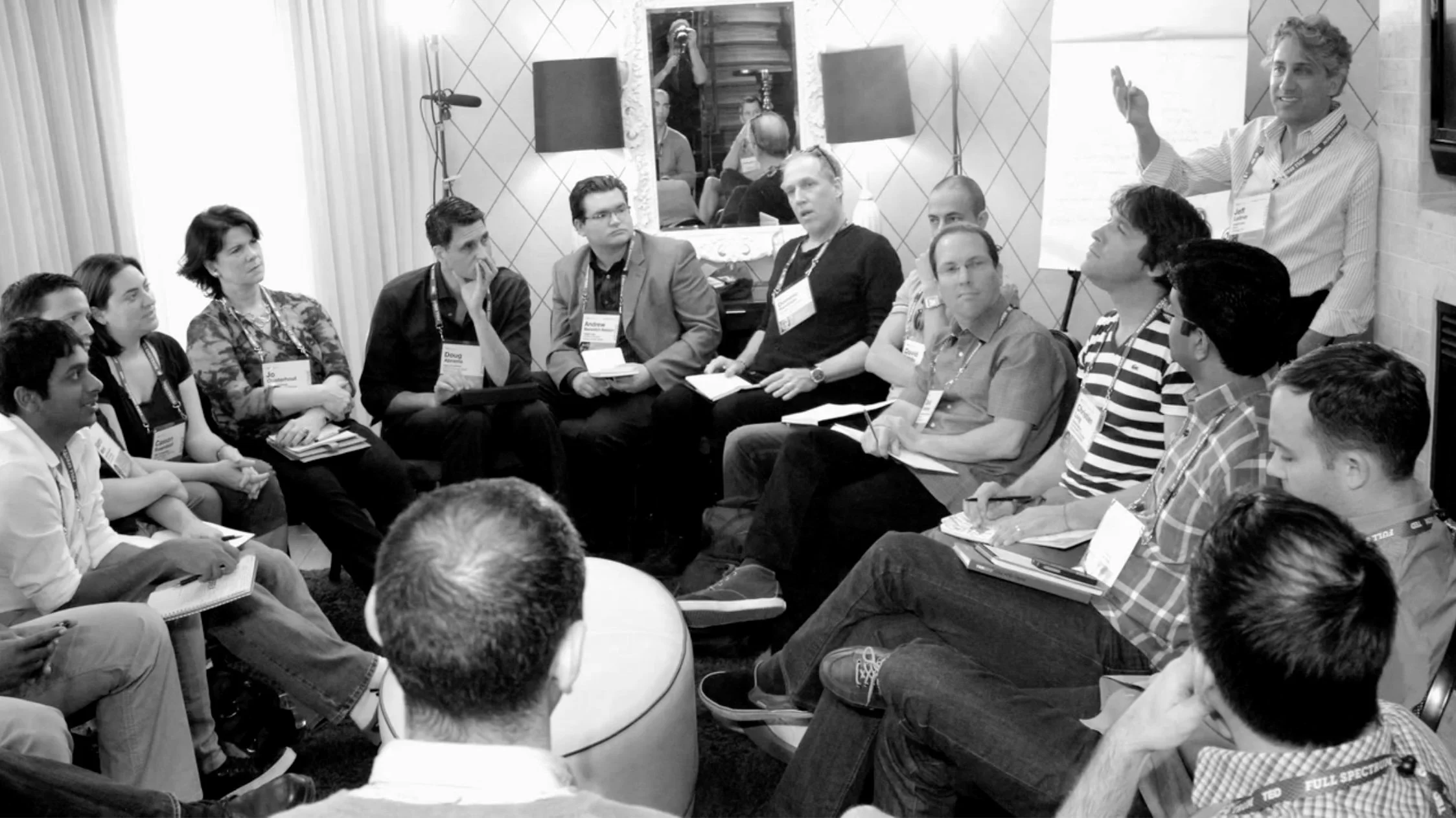
Instigating social innovation with Insight Labs and GreenHouse (2010 - 2017)
Leaders of every kind of organization sometimes need to get out of their own way. We all have unquestioned assumptions that limit our view of what we can accomplish.
Insight Labs was an organization designed to help as many organizations as possible overcome these blind spots. Through our signature offering, the intensive strategy sessions (“Labs”) designed by Jeff Leitner, we helped more than 60 groups confront questions essential to executing their missions. Partners included NASA, the U.S. State Department, TED, Ashoka, Starbucks, and the U.S. Holocaust Memorial Museum. A number of Labs projects also contributed to my perspective on how healers lead, including work with Harvard Medical School and Walter Reed National Military Medical Center.
Insight Labs was also an incubator for many other social innovation projects. We played a key role in the development of the design initiative UX for Good, which tackled problems such as mindfulness education, genocide prevention, and pediatric cancer. With the spinoff consulting firm GreenHouse, I conducted research on the patient experience of ovarian cancer and led discussions about how to best intervene.
With my Labs colleagues, I also created several methodologies that continue to inform my work. I created a practical approach to design thinking that I have since applied with hundreds of students as well as individual coaching clients. We also developed an approach to social change strategy that I have since adapted into the Social Lens Framework.
But to me, the real legacy of Insight Labs is a fearlessness in the face of any issue, not matter how complex or contentious. I feel confident that no matter what situation may arise, something from this vast library of strategic conversations will provide a starting point. For example, when recently consulting with a nursing organization, I drew upon tools first developed to help reorganize a contemporary art museum more than a decade ago. Working with me gives you access to all these tools and my conviction that they can be adapted to any problem.